
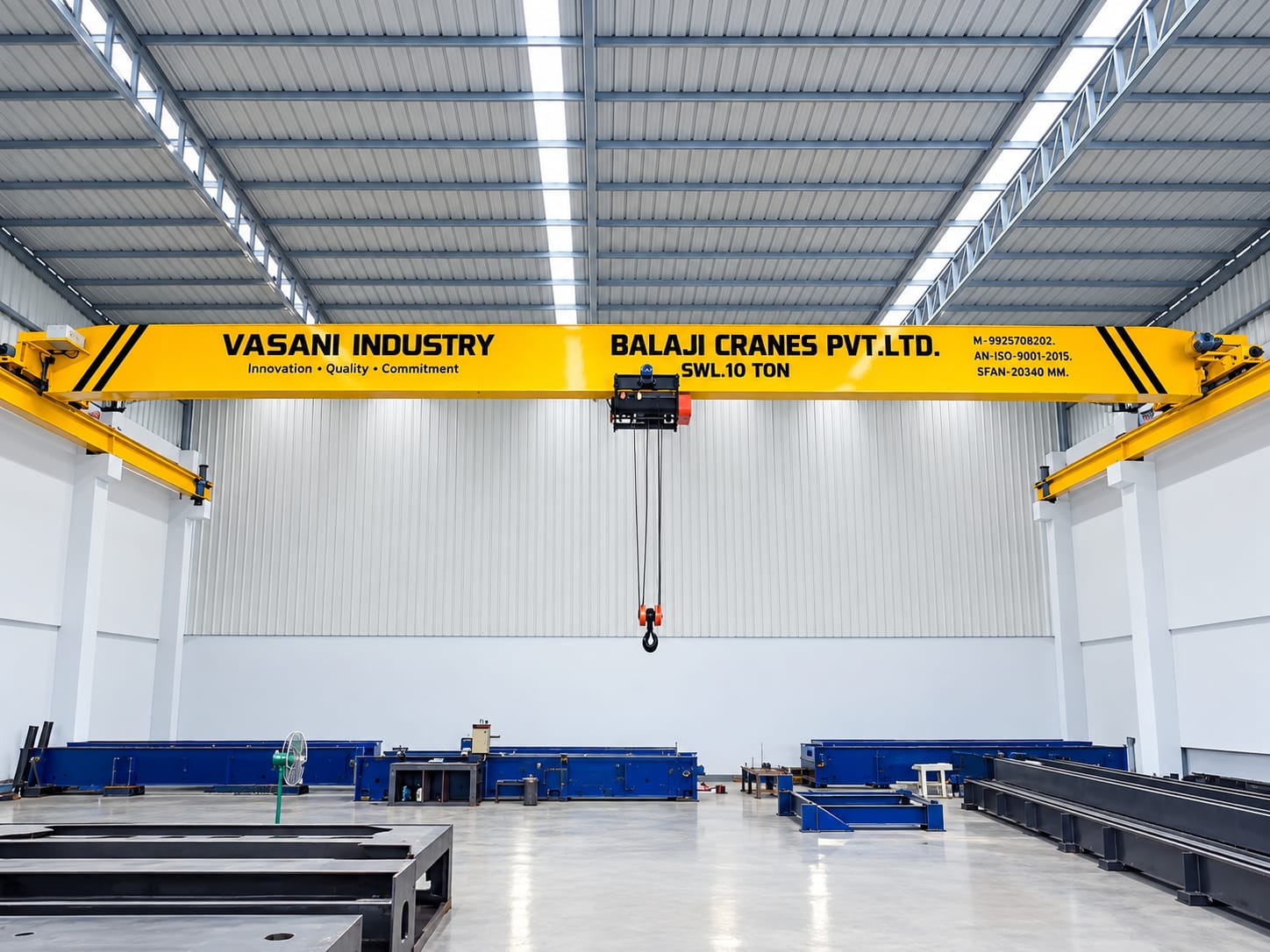
Single Girder Overhead Cranes
Description
Single Girder Overhead Crane Manufacturer in Ahmedabad, Gujarat, India – Balaji Crane Private Limited
Single Girder Overhead Cranes for Industrial Material Handling
Balaji Crane Private Limited provides industrial crane and material handling solutions for manufacturing units, engineering workshops, warehouses, fabrication facilities, and other industrial applications. Single Girder Overhead Cranes are widely used for lifting, lowering, and transporting materials efficiently within designated working areas.
A Single Girder Overhead Crane consists of one main bridge girder supported by end carriages that travel along elevated runway rails. A suitable electric wire rope hoist or chain hoist is installed on the bridge to lift and lower loads. The crane can move horizontally across the bridge and along the runway, enabling material handling across a defined working area.
Single Girder Overhead Cranes are often considered for light- to medium-duty lifting applications, depending on the required capacity, span, lifting height, and operating duty. They can help optimize floor space, reduce manual material handling, and improve production workflow.
Balaji Crane Private Limited can be approached to discuss project-specific overhead crane requirements in Ahmedabad, Gujarat, and other locations according to the agreed project scope.
What Is a Single Girder Overhead Crane?
A Single Girder Overhead Crane is an overhead lifting system that uses one main horizontal bridge girder to support a hoisting mechanism. The bridge travels along elevated runway beams, while the hoist trolley moves along the girder to position loads horizontally.
The crane's principal components include the bridge girder, end carriages, wheels, hoist, trolley, motors, brakes, electrical controls, and applicable safety devices.
Compared with a double girder arrangement, a single girder design generally uses a simpler bridge structure. Its suitability depends on the lifting capacity, span, hook height, duty classification, and operational requirements of the facility.
Main Components of a Single Girder Overhead Crane
1. Main Bridge Girder
The main structural beam supports the hoisting equipment and carries the loads transferred through the crane system. It must be designed for the specified load, span, deflection limits, and operating duty.
2. End Carriages
End carriages are fitted at the ends of the bridge and support the travel wheels and associated drive arrangements.
3. Electric Hoist
An electric wire rope hoist or electric chain hoist raises and lowers the load according to the crane's rated capacity and intended application.
4. Hoist Trolley
The trolley travels along the main girder and positions the hoist over the required lifting point.
5. Long-Travel Drive
The long-travel mechanism moves the complete crane along the elevated runway rails.
6. Electrical Control System
The control system operates the hoisting, cross-travel, and long-travel functions. Pendant or compatible radio remote controls may be selected according to the design.
7. Braking and Safety Devices
Suitable brakes, limit switches, travel limits, overload protection where applicable, and other safety provisions support controlled operation.
Types of Single Girder Overhead Cranes
1. Top-Running Single Girder Overhead Crane
In this arrangement, the crane bridge travels on rails installed on top of elevated runway beams. It is suitable where the building structure or dedicated supporting columns can accommodate the runway system.
Applications: Manufacturing plants, engineering facilities, warehouses, and fabrication workshops.
2. Under-Running Single Girder Overhead Crane
An under-running crane travels on a suitable track or runway arrangement suspended from the building structure. It can be useful where the supporting structure is designed for the required loads and overhead clearance is limited.
Applications: Selected production bays, assembly areas, and facilities with suitable roof or structural support.
3. Single Girder Crane with Electric Wire Rope Hoist
This configuration uses an electric wire rope hoist and trolley to provide lifting and horizontal positioning. It can be considered for applications requiring the relevant lifting height, speed, and duty.
4. Single Girder Crane with Electric Chain Hoist
An electric chain hoist may be used when it meets the load, lifting height, operating frequency, and installation requirements of the application.
The final crane arrangement should be selected according to the building structure, load characteristics, required hook height, span, and operating conditions.
Technical Specifications of Single Girder Overhead Cranes
The following table identifies the principal design parameters. Actual specifications should be confirmed for the selected crane model and project.
Technical Parameter
Specification / Selection Criteria
Crane Type
Single Girder Overhead Travelling Crane
Rated Lifting Capacity
Selected according to the required safe working load
Crane Span
Customized according to the building layout
Lifting Height
Based on hook travel and available headroom
Hoisting Mechanism
Electric Wire Rope Hoist or Electric Chain Hoist
Cross Travel
Manual or powered, as appropriate to the design
Long Travel
Powered or other suitable travel arrangement
Bridge Girder
Engineered structural steel section or fabricated girder
Runway Arrangement
Top-running or under-running, depending on design
Hoisting Speed
Selected according to operational requirements
Travel Speed
Based on handling needs and crane configuration
Control System
Pendant, radio remote, or compatible control arrangement
Power Supply
Finalized according to the selected motors and site electrical system
Duty Classification
Selected according to lifting frequency and service intensity
Safety Provisions
Suitable brakes, limits, and applicable protective devices
Installation
Building-supported or dedicated runway structure, as applicable
Technical note: Capacity, span, motor ratings, speed, deflection, and duty classification must be determined through engineering assessment. The supporting structure, runway beams, columns, foundations, and electrical system must also be suitable for the crane loads.
Working Principle of a Single Girder Overhead Crane
A Single Girder Overhead Crane performs material handling through three primary movements: hoisting, cross travel, and long travel.
Load Attachment: The operator attaches the load to a suitable hook or approved lifting attachment.
Hoisting: The electric hoist raises or lowers the load under controlled operation.
Cross Travel: The trolley moves along the main bridge girder to position the load.
Long Travel: The complete bridge travels along the elevated runway rails.
Load Placement: The operator lowers the load into the designated location and releases the lifting attachment after the load is safely supported.
These movements allow materials to be transported across the crane's designated working area. Operators must follow approved procedures, avoid overloading, and keep personnel clear of suspended loads.
Applications of Single Girder Overhead Cranes
Single Girder Overhead Cranes are commonly used in the following industries:
Manufacturing Industries: Handling raw materials, machine parts, and finished products.
Engineering Workshops: Lifting heavy components during assembly and maintenance.
Steel Fabrication Units: Moving steel sections, fabricated parts, and metal components.
Automobile Industries: Handling assemblies, spare parts, and production components.
Warehouses: Moving goods between storage, processing, and dispatch areas.
Packaging Units: Supporting material movement across packing and production stations.
Machine Shops: Loading and unloading components from industrial machinery.
Foundries: Handling suitable loads in appropriately designed industrial environments.
Maintenance Facilities: Supporting the removal, movement, and installation of equipment.
Industrial Assembly Lines: Improving the movement of components between workstations.
Benefits of Single Girder Overhead Cranes
1. Efficient Material Handling
The crane's lifting and travel movements support the transportation of materials across a designated working area.
2. Better Floor-Space Utilization
Because the crane operates overhead, it can help keep floor space available for production, storage, and movement.
3. Practical Structural Configuration
A single girder arrangement can offer a simpler bridge design than a double girder crane where the application permits it.
4. Improved Workplace Productivity
Mechanical lifting reduces reliance on manual handling and can streamline repetitive industrial operations.
5. Flexible Hoist Selection
Suitable electric wire rope hoists or chain hoists can be selected according to the lifting requirements and crane configuration.
6. Adaptability to Different Facilities
The crane span, lifting height, travel arrangement, and control system can be planned according to the project requirements.
7. Controlled Load Positioning
Hoisting, cross travel, and long travel help operators move loads to designated positions within the crane's approved working envelope.
Why Choose Balaji Crane Private Limited?
Balaji Crane Private Limited can be approached for industrial crane and material handling requirements involving Single Girder Overhead Cranes.
Assistance in evaluating suitable crane configurations.
Project-specific consideration of rated capacity, span, and lifting height.
Selection of appropriate hoist and trolley arrangements.
Consideration of building clearance and runway support requirements.
Evaluation of control arrangements and relevant safety provisions.
For a crane enquiry, provide the required lifting capacity, building span, lifting height, runway length, operating frequency, and installation location. These details help establish the appropriate technical configuration.
Frequently Asked Questions (Q&A) About Single Girder Overhead Cranes
Q1. What is a Single Girder Overhead Crane?
A Single Girder Overhead Crane is a lifting system that uses one main bridge girder supported by end carriages. A hoist and trolley move loads vertically and horizontally within the crane's working area.
Q2. What is the main purpose of a Single Girder Overhead Crane?
Its main purpose is to lift, lower, and transport materials within manufacturing plants, warehouses, workshops, fabrication units, and other industrial facilities.
Q3. What is the difference between single girder and double girder overhead cranes?
A single girder crane has one main bridge girder, while a double girder crane has two. The choice depends on lifting capacity, span, hook height, duty classification, and operational requirements.
Q4. What lifting capacity is available for a Single Girder Overhead Crane?
The available capacity depends on the manufacturer's design range and project specifications. The selected crane must be engineered for the intended rated load, span, duty, and operating conditions.
Q5. What type of hoist is used in a Single Girder Overhead Crane?
An electric wire rope hoist or electric chain hoist may be used. Selection depends on load capacity, lifting height, speed, duty classification, and available headroom.
Q6. What is a top-running Single Girder Overhead Crane?
A top-running crane travels on rails installed on top of elevated runway beams. Its supporting structure must be designed for the crane's vertical, horizontal, and dynamic loads.
Q7. What is an under-running Single Girder Overhead Crane?
An under-running crane travels on a suitable track suspended from the building structure. It is appropriate only when the supporting structure and runway arrangement are engineered for the required loads.
Q8. Can a Single Girder Overhead Crane be customized?
Yes. The crane can be specified according to the required span, lifting capacity, lifting height, hoist type, travel speed, control system, and installation arrangement, subject to the manufacturer's design capabilities.
Q9. What safety features are required in an overhead crane?
Depending on the design and applicable regulations, safety provisions may include hoist brakes, upper limit switches, travel limits, overload protection where required, emergency stop controls, and appropriate electrical protections.
Q10. Can a Single Girder Overhead Crane be installed in an existing factory?
It may be possible after evaluating the building structure, runway support, available headroom, column positions, power supply, and installation clearances. Structural suitability must be verified before installation.
Q11. How often should a Single Girder Overhead Crane be maintained?
Maintenance frequency depends on usage, operating conditions, manufacturer's instructions, and applicable requirements. Regular inspections should cover the hoist, wire rope or chain, hook, brakes, wheels, rails, electrical equipment, and structural components.